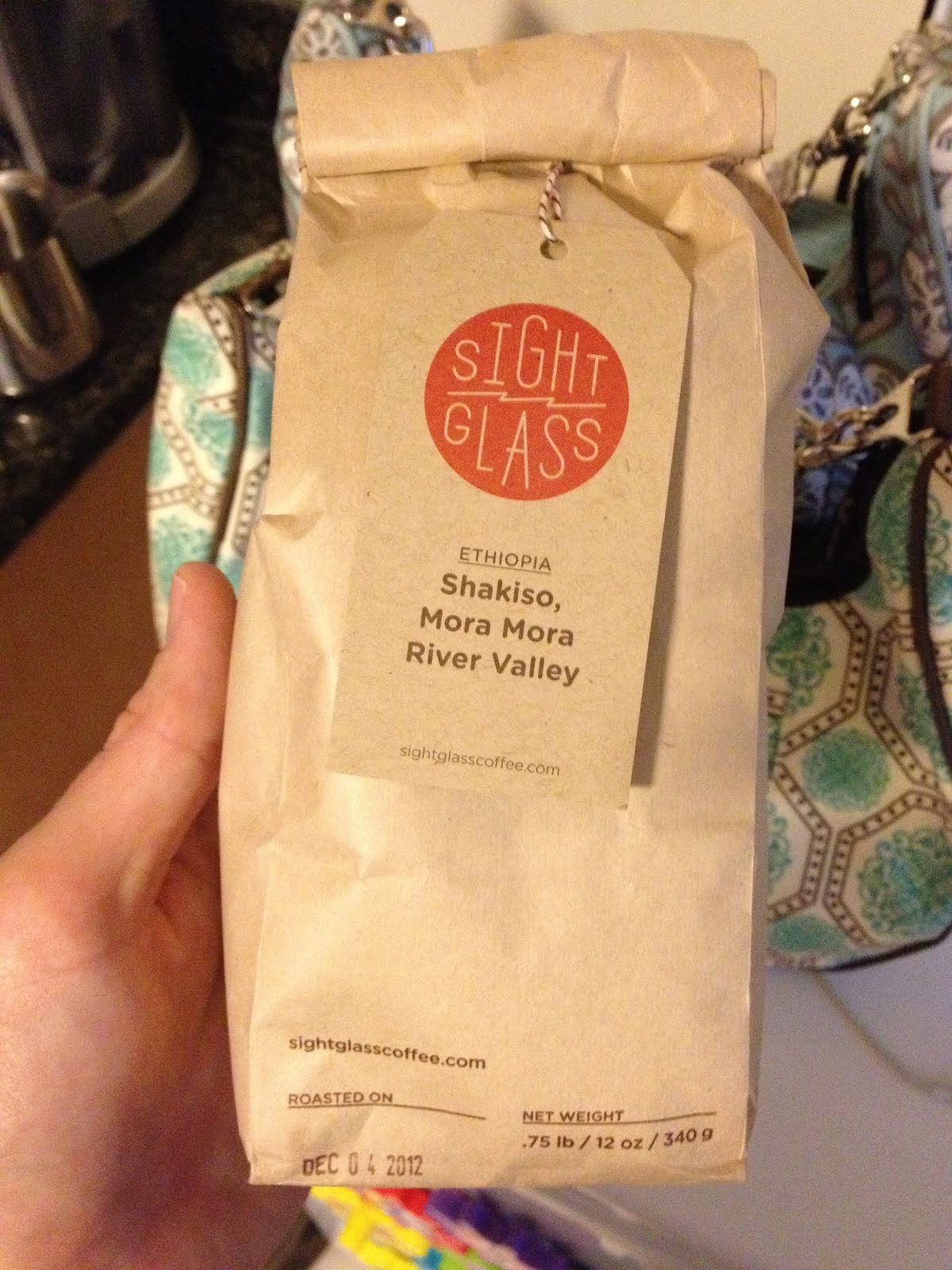
It seems like Four Barrel is really hitting its stride when it comes to roasting fresh coffee beans. I am currently enjoying their Ethiopia Mordecofe Natural Process and it's showing wonderful blueberry and apricot notes and a striking citrus-like acidity. In the past, their coffees seemed tired and roasted at levels that didn't fully show their best flavors.
Natural process means the coffee cherry fruit was left attached to the bean (as opposed to being removed as is more typical in the washed process) and as a result, the coffee has more funky fruit flavors that might have been gone otherwise. Though interestingly enough, the acidity remains, which tends to be muted when made in this manor.
So far I've prepared this coffee in an inverted aeropress, french press, and in espresso form. My only attempt at pulling this coffee was a failure, I choked my poor Gaggia, requiring 56 seconds to get maybe half the amount of a single shot. So I'll retry that soon and figure out how to properly dial this thing in (still, the espresso I got tasted great with steamed milk - the blueberry flavor shown through like a spotlight in fog). I liked this as a french press, but overall the flavors seemed muted a bit. The inverted aeropress version I'm drinking this morning is the best preparation so far - bright acidity, wonderfully sharp flavors, and a nice clean cup.
Priced at $13, Four Barrel describes this coffee's taste as "Intense strawberry throughout, blueberry and apricot jam, passion fruit, apricot, and vanilla cookie."
Sunday, December 20, 2009
Tuesday, December 15, 2009
Robert Stemmler 2006 Estate Pinot Noir Carnaros

Picked up this wine from Wine.com's shop in Berkeley for $19.99, down from it's original $36. Wasn't entirely certain this would be a good offering given my poor track record with sub-$20 pinots, but the label was
beautiful, the producer was one I thought I'd heard of being good, and the
in-store write up didn't mention "a touch of wood" in the tasting notes like the
other wine I was considering (whenever I see that I shudder because it usually
means the wine is over oaked).
When I got home and looked up what the producer had to say about the 2006 growing season, it bothered the crap out of me. The problems with the season seemed biblical in nature - flooding, "brutal" hot weather, and an overabundant crop that was picked late in the season caused me to think the wine would be thin and taste like raisin-flavored vodka.
Lucky for me, the wine was excellent, displaying an earthy nose with petrol and
cherry notes, which echoed in the glass. There was hints of black liquorish
on the finish. The winery did a good job of "aggressive" green pruning, so that the remaining berries were able to display great flavor and not the watered down taste I expected.
I really liked this wine and think it's a great deal for under $20.
Saturday, November 28, 2009
Four Barrel Ethiopia Sidamo Mordecofe
My appreciation for Four Barrel Coffee continues to climb the more I visit their shop on Valencia and 16th St. in San Francisco. Initially wowed by the atmosphere, machinery and great minds behind the shop's concept during my first visit in August 2008, subsequent trips have left me disappointed with the quality of the beans that I bought to brew at home. While the desserts are fantastic (chocolate and salt donut=yum) and in cafe espresso-based drinks are nice, some of the beans just seemed tired, over-roasted or plain boring.
But I'm an optimist. So I went back and picked up a bag of the Ethiopia Sidamo Mordecofe, which was roasted on Nov. 9. The coffee, priced at $12.50, is organic and direct trade. Four Barrel's tasting notes described it as: "A clean tea-like body, with bergamot aroma, notes of raspberry lemonade, and a peachy acidity."
I was really impressed with this bag. Showing best in a pour over, I definitely found it to have a tea-like flavor, followed by blueberries, some floral and earthy components, and a finish that hinted of oranges and a bit of lavender. Wonderful coffee and great price, definitely worth picking up.
But I'm an optimist. So I went back and picked up a bag of the Ethiopia Sidamo Mordecofe, which was roasted on Nov. 9. The coffee, priced at $12.50, is organic and direct trade. Four Barrel's tasting notes described it as: "A clean tea-like body, with bergamot aroma, notes of raspberry lemonade, and a peachy acidity."
I was really impressed with this bag. Showing best in a pour over, I definitely found it to have a tea-like flavor, followed by blueberries, some floral and earthy components, and a finish that hinted of oranges and a bit of lavender. Wonderful coffee and great price, definitely worth picking up.
Friday, November 27, 2009
Il Barbaresco 1997
This is a weird one. I walked into a small, sort of dingy shop in Oakland where I had heard there were many good microbrews. I was looking to stock up on some odd and unique beers for a pizza and brew night with another couple when I came across a shelf near the register of a wine with a simple red label with white lettering that said "Il Barbaresco."
Didn't see anything else except the DOCG ring on the top of the bottle. On the back is the producer's name, "Tenuta San Mauro," and the year 1997. The price? just $3.99. Yes, that's not $39.99 or $399.99, but a measily four bucks.
"What the deal with this wine?" I asked, incredulously, to the shop keeper.
"Oh yes it's very good," he said. But how did he get it? Was a distributor dumping unsold older wines? Was it a fire sale? Were they actually in a fire? I had tons of questions and no one to really ask, since the clerk didn't seem aware of the wine's history. The shop's wine selection itself was much less impressive than it's amazing beer offerings. Most of the wine bottles were under $10-mass produced picks that you'll find at any corner liquor store. So suddenly out of no where they're pulling out a 1997 Barbaresco? The bottle looked brand new too, and in fact I assumed it was either a non-vintage (which I'm not even sure they make for Barbarescos) or some misprint with the label. Why would the vintage be on the back? And again, how did this little shop get the wine? WTF?
Barbaresco is made from the Nebbiolo grape, the same grape used to make Italy's famed Barolos. Known for it's spiciness and rich cherry flavors, Barbarescos are considered more feminine than Barolos, though they can get expensive, and can age for decades. Just looking at wine searcher, I see about two dozen 1997 Barbarescos priced from $30 to $112.
The Nebbiolo grape can make extremely tannic wines, with high acidity and sour flavors, so if you drink them too young, they can be unappealing. DOCG status means this wine had to see at least two years of aging (at least one year in oak) before being released, and the grapes must come from Italy's northwestern Piedmont region.
Anyway, I jumped at the chance to try a 12-year old Barbaresco for $3.99. If it was horrible, oxidized, or somethinge else, then I'm not losing out that much.
What I got was a mixed bag. When I poured this wine, I saw a pretty brick color, indicating the wine has seen some age. After letting it get some air, I found massive earthy aromatics, with tobacco leaf dominating other aromas of nutmeg and menthol.
"Wonderful nose - could sniff for hours," I wrote in my journal. Got me all hot and bothered for some awesome aged Barbaresco for four freakin' dollars!!!!!!
Yet this where the disappointment set in. The wine itself tasted a lot like the aromas I found in the nose -- tobacco leaf, mixed spices, mentol, but after a strong attack, the wine fell apart on the mid palate, and ended in a mess of sour sour cherry and dry, busted tannins. The end result didn't even taste like it was wine - there was no fruitiness, no freshness or life at all.
Sigh.
Well, I'm not sad I took a chance on this, and I might even buy another bottle to see if the result is any different. The reason why I wrote this as a posting is because despite the bad vino, I love the sense of discovery that you can have with bottles like these. While I can't find any info on the producer at all online, or vintage reports from the most recent books, it's still sort of like opening a time capsule and seeing what has been stored in the bottle for all those years.
Didn't see anything else except the DOCG ring on the top of the bottle. On the back is the producer's name, "Tenuta San Mauro," and the year 1997. The price? just $3.99. Yes, that's not $39.99 or $399.99, but a measily four bucks.
"What the deal with this wine?" I asked, incredulously, to the shop keeper.
"Oh yes it's very good," he said. But how did he get it? Was a distributor dumping unsold older wines? Was it a fire sale? Were they actually in a fire? I had tons of questions and no one to really ask, since the clerk didn't seem aware of the wine's history. The shop's wine selection itself was much less impressive than it's amazing beer offerings. Most of the wine bottles were under $10-mass produced picks that you'll find at any corner liquor store. So suddenly out of no where they're pulling out a 1997 Barbaresco? The bottle looked brand new too, and in fact I assumed it was either a non-vintage (which I'm not even sure they make for Barbarescos) or some misprint with the label. Why would the vintage be on the back? And again, how did this little shop get the wine? WTF?
Barbaresco is made from the Nebbiolo grape, the same grape used to make Italy's famed Barolos. Known for it's spiciness and rich cherry flavors, Barbarescos are considered more feminine than Barolos, though they can get expensive, and can age for decades. Just looking at wine searcher, I see about two dozen 1997 Barbarescos priced from $30 to $112.
The Nebbiolo grape can make extremely tannic wines, with high acidity and sour flavors, so if you drink them too young, they can be unappealing. DOCG status means this wine had to see at least two years of aging (at least one year in oak) before being released, and the grapes must come from Italy's northwestern Piedmont region.
Anyway, I jumped at the chance to try a 12-year old Barbaresco for $3.99. If it was horrible, oxidized, or somethinge else, then I'm not losing out that much.
What I got was a mixed bag. When I poured this wine, I saw a pretty brick color, indicating the wine has seen some age. After letting it get some air, I found massive earthy aromatics, with tobacco leaf dominating other aromas of nutmeg and menthol.
"Wonderful nose - could sniff for hours," I wrote in my journal. Got me all hot and bothered for some awesome aged Barbaresco for four freakin' dollars!!!!!!
Yet this where the disappointment set in. The wine itself tasted a lot like the aromas I found in the nose -- tobacco leaf, mixed spices, mentol, but after a strong attack, the wine fell apart on the mid palate, and ended in a mess of sour sour cherry and dry, busted tannins. The end result didn't even taste like it was wine - there was no fruitiness, no freshness or life at all.
Sigh.
Well, I'm not sad I took a chance on this, and I might even buy another bottle to see if the result is any different. The reason why I wrote this as a posting is because despite the bad vino, I love the sense of discovery that you can have with bottles like these. While I can't find any info on the producer at all online, or vintage reports from the most recent books, it's still sort of like opening a time capsule and seeing what has been stored in the bottle for all those years.
Thursday, November 19, 2009
Cool Way to get Coffee/Wine Gifts.....

I just found the coolest thing today for helping helpless relatives buy me gifts I actually want for Christmas (yes I am that self-centered). Normally I just add stuff to my Amazon.com wish list, and tell all the relatives who want to know what to get me to check out the list. This year it's full of books about wine. Unfortunately my time for actually reading these things has diminished since having my second child in August.
But then I saw a little notice on the site today saying I could have a "add to wish list" button to my browser...oh....my....god.... instead of being limited to only products sold through Amazon, I can now go to any web page, and "add" a product to my wish list.
I've spent the morning using this tool to add bottles of wine from K&L Wines to my wish list, such as the
2007 Mönchhof Erdener Prälat Riesling Auslese for $29.99 (normally $45) off of K&L's clearance list. I'm all about sweet German rieslings ever since I wrote about them a month ago.
I have a bevy of coffee sites to check out later today as well for special gifts I want. Wouldn't that be cool? To get a pound of a really sweet coffee or a rare or interesting (yet still affordable) bottle of wine for Christmas? I'm way to excited about this....and probably won't get either. But still! Just the idea of it!
Sunday, November 15, 2009
A Tale of Two Wines
So I know it's been like a long long long time since my last post, and I'm sorry. I have three excuses that I hope you'll buy.
1) New baby
My son, Rowan, was born three months ago and basically any free time I had before after work to write blog posts has gone out the window. As soon as I walk in the door, I quickly change into shorts and a T-shirt (god I love the weather out here in Oakland) and then am handed a warm, squirmy, drooling infant while Rhonda takes a break. Then I make dinner, give my daughter a bath, put her down, do whatever chores I'm assigned that night, and take the baby back until he needs to feed. And then I burp him. So you see, less free time.
2) Writing about wine for work
For the past few months I've been writing about wine for work, and have been receiving review samples and drinking a lot on the corporate dime, so I can't discuss those things here, unfortunately.
3) I'm lazy/procrastinate
Moving along swiftly to wine reviews....
I headed over to Wine.com's shop in Berkeley a few weeks ago because they had a $50 Cote Rotie for sale, half off. Cote Rotie, which means "roasted slope," (named because of the hills the sun bakes) is located in the northern most portion of France's Rhone region. Wines are primarily made from syrah and can include some viognier, but are known for some of the Rhone's best wines, having a spicy, full berry flavor and can age incredibly well.
The wine in question was the 2004 Domaine Duclaux. Now, I figured it was on sale for a reason - the distributor needed to move bottles being the most common reason today why things go on sale like this. So I took a chance, hoping for a winning lottery ticket. Well like all lottery tickets I buy, I lost. This wine was a poor example of what the syrah grape can produce. On the nose I got currants, steel, and musty cellar. In the glass, I got a cocktail of red berries with a varying degree of ripeness, with an overall sensation of too ripe fruit, bordering on raisiny. The wine was thin on the mid-palate, and finished with a tart acidity.
Checking out what Robert Parker had to say about the vintage explained what went wrong. Apparently 2004 was a very productive year with mixed weather, so chateaux that didn't prune a lot before harvest ended up with too many grapes. This is a problem because the vines spread out it's growing efforts and produce thin tasting fruit. If a grower cuts back the amount of fruit on a vine during the growing season, the vine will concentrate its efforts on the remaining grapes, producing more flavorful fruit. Of course, if you're livelihood depends on selling fruit by the ton, or selling more bottles, cutting back a lot of your fruit can hurt the wallet. So I totally feel for the farmers...
Even at $25, this was overpriced.
But my trip to Wine.com wasn't a total waste. One of the workers there (red hair and beard, very talkative, very knowledgeable about French wines) suggested a 2007 Marcel Lapierre Morgon (gamay) for $25. The producer is biodynamic, and the wine was made with little intervention. Overall I loved this wine - it had an intreguing nose of christmas spice, varnish and black peppercorn. In the mouth I got rose petals, dust, dried cherries and a racy acidity with stealthy tannins that appear at the end without you really noticing at first. This is a nervy wine that would be great for a Thanksgiving meal.
I'm hoping to write more from now on, but as I'm typing this, the baby is crying hysterically and Rhonda is giving me evil eyes...so until next time....
1) New baby
My son, Rowan, was born three months ago and basically any free time I had before after work to write blog posts has gone out the window. As soon as I walk in the door, I quickly change into shorts and a T-shirt (god I love the weather out here in Oakland) and then am handed a warm, squirmy, drooling infant while Rhonda takes a break. Then I make dinner, give my daughter a bath, put her down, do whatever chores I'm assigned that night, and take the baby back until he needs to feed. And then I burp him. So you see, less free time.
2) Writing about wine for work
For the past few months I've been writing about wine for work, and have been receiving review samples and drinking a lot on the corporate dime, so I can't discuss those things here, unfortunately.
3) I'm lazy/procrastinate
Moving along swiftly to wine reviews....
I headed over to Wine.com's shop in Berkeley a few weeks ago because they had a $50 Cote Rotie for sale, half off. Cote Rotie, which means "roasted slope," (named because of the hills the sun bakes) is located in the northern most portion of France's Rhone region. Wines are primarily made from syrah and can include some viognier, but are known for some of the Rhone's best wines, having a spicy, full berry flavor and can age incredibly well.
The wine in question was the 2004 Domaine Duclaux. Now, I figured it was on sale for a reason - the distributor needed to move bottles being the most common reason today why things go on sale like this. So I took a chance, hoping for a winning lottery ticket. Well like all lottery tickets I buy, I lost. This wine was a poor example of what the syrah grape can produce. On the nose I got currants, steel, and musty cellar. In the glass, I got a cocktail of red berries with a varying degree of ripeness, with an overall sensation of too ripe fruit, bordering on raisiny. The wine was thin on the mid-palate, and finished with a tart acidity.
Checking out what Robert Parker had to say about the vintage explained what went wrong. Apparently 2004 was a very productive year with mixed weather, so chateaux that didn't prune a lot before harvest ended up with too many grapes. This is a problem because the vines spread out it's growing efforts and produce thin tasting fruit. If a grower cuts back the amount of fruit on a vine during the growing season, the vine will concentrate its efforts on the remaining grapes, producing more flavorful fruit. Of course, if you're livelihood depends on selling fruit by the ton, or selling more bottles, cutting back a lot of your fruit can hurt the wallet. So I totally feel for the farmers...
Even at $25, this was overpriced.
But my trip to Wine.com wasn't a total waste. One of the workers there (red hair and beard, very talkative, very knowledgeable about French wines) suggested a 2007 Marcel Lapierre Morgon (gamay) for $25. The producer is biodynamic, and the wine was made with little intervention. Overall I loved this wine - it had an intreguing nose of christmas spice, varnish and black peppercorn. In the mouth I got rose petals, dust, dried cherries and a racy acidity with stealthy tannins that appear at the end without you really noticing at first. This is a nervy wine that would be great for a Thanksgiving meal.
I'm hoping to write more from now on, but as I'm typing this, the baby is crying hysterically and Rhonda is giving me evil eyes...so until next time....
Labels:
biodynamic,
cote rotie,
gamay,
morgon,
syrah,
wine.com
Sunday, September 27, 2009
Some coffee notes.....
Been longer than I would have liked between posts, just haven't been able to give this as much time as I've wanted recently. For one, I've been busy at work with some coffee and wine reviews, so I can't really write about the exciting things I've been drinking here until I finish my articles and get them out. Second, I have an infant that doesn't want to be put down at all, ever, so typing with one had and holding a squirmly little boy takes more skill than I currently possess.
Nonetheless, I wanted to put out some coffee tasting notes.
The first is Ritual Roasters' Ndumberi Peaberry (coffee bean variety SL-28). Ritual's notes said this coffee had strawberry shortcake, raspberry and lemon curd in the cup. I got more dried red berry fruits, like raspberries. This coffee had a huge acidity component to it, which I liked.
The second coffee I had was Barefoot Roasters' Guatemalan FVH Edlyna. Purchased at Whole Foods for $11.99, this coffee had a lovely silk body, with subtle berry flavors and some wood and melted butter notes.
Nonetheless, I wanted to put out some coffee tasting notes.
The first is Ritual Roasters' Ndumberi Peaberry (coffee bean variety SL-28). Ritual's notes said this coffee had strawberry shortcake, raspberry and lemon curd in the cup. I got more dried red berry fruits, like raspberries. This coffee had a huge acidity component to it, which I liked.
The second coffee I had was Barefoot Roasters' Guatemalan FVH Edlyna. Purchased at Whole Foods for $11.99, this coffee had a lovely silk body, with subtle berry flavors and some wood and melted butter notes.
Wednesday, September 16, 2009
2008 Skouras White

I have a fondness for Greek wines, even if I only drink it very rarely. That's because I first started drinking wine on a regular basis when I was studying abroad in Greece during college.
I remember not liking red wine at first, because it was served warm, and I couldn't comprehend drinking a warm, or room temperature beverage with food (that's an American thing, apparently).
Still, the novelty of being able to buy alcohol at will (I was only 20) and the idea of drinking wine with dinner as what sophisticated people did, compelled me to try the various bottles on the shelves.
It wasn't long until I was exploring the wines of Greece, and loving every glass, from Xinomavro wines of Naoussa to Agiorgitiko wines of Nemea, as well as the sweet, dark dessert wine Mavrodaphne to the cheap, available in every bar, pine sol tasting Restina.
After I moved back to the US, I continued drinking wine on a regular basis, but shifted to the cheap wines I found here, which were mainly California plonk.
When I moved to California, and Oakland specifically, I came across a wine shop called Du Vin Fine Wines in Alameda that specialized in Greek wines (they have a good selection of Portuguese and Italian wines as well).
As I'm on an obscure Italian wine kick, I decided to see what they had last weekend. I was able to get a Lacrima di Morro, my current favorite red, and I asked him to suggest an off-beat white wine as well. The main one he wanted to sell me was out, but he suggested instead the 2008 Skouras White, a 60/40 blend of Roditis and Moscofilero, two native Greek grapes. As a bonus, the bottle was only $10.99.
Back home, I found this wine to have an earthy nose with a slight blue cheese mold tint to it. In the mouth, this dry wine had bright acidity and seemed to have a slight effervescence. Steely while cold, flavors of almonds and honey appeared as it warmed.
Overall, and interesting wine for $10.99, but nothing too exciting. I believe the wine the shop owner wanted me to try was a 100 percent Moscofilero, which the site All About Greek Wine describes as "A distinct aromatic grape from within the AOC region of Mantinia, in the Peloponnese, Moschofilero grapes have a gray colored skin and therefore produce a wine that is a blanc de gris. Its crisp character and beautiful floral aroma of roses and violets with hints of spices can be drunk as an aperitif or with food." Sounds good - I'll have to seek something like that out!
Sunday, September 13, 2009
2006 Thomas Coyne Petit Verdot
A few years ago I took some friends of mine to a wine trip to Livermore. They had wanted to visit Napa, but I've spent too much time stuck in traffic waiting to get to packed tasting rooms where the winery charges $10 for three little tastes, then offers you the option of tasting "reserve" wines for $15 more, and a futher "library" tasting for another fee. You can spend $40 in a tasting room trying wine without yet buying a bottle, which are themselves $40 and up. Plus you're fighting crowds.
Livermore has dozens of wineries, many that are smaller operations. Some of these I visited were literally in the garage of the grape grower. While you may not get astounding wines at every stop, you're bound to find a few great ones that won't cost you a ton of money simply because it was made in Napa.
One of the places we visited was Thomas Coyne Winery, a hard to find but worth visiting location in south Livermore. Specializing in Rhone and Bordeaux varietals, winemaker Thomas Coyne (pronounced "Coin") started making wine in 1989. The winery itself is on a hill in the middle of in an 1881 building built by French engineer Alexander Duvall. You can see Mt. Diablo in the background, and overall it's a really pretty place to try some wines.
All of the wines I tried tasted great, and I in particular liked the Petit Verdot. You can get these at Whole Foods as well.
The Petit Verdot, priced at $18, looked as black as night in the glass. On the nose, I found sweet jammy black fruit, and this followed in the mouth, as it presented ripe blackberry jam with a touch of vanilla and heat on the finish. Really thick mouthfeel, with the fruit flavors sparkling as a bright beam.
From the winery: "This little-known Bordeaux Varietal is normally reserved for blending to enhance color and body of the major varietals. The grapes came from a vineyard near Lodi in Northern California. After crush and fermentation, the wine was aged in American and French oak barrels for eighteen months. The wine is full-bodied in character with intense herbal flavors and rich oak finish."
Livermore has dozens of wineries, many that are smaller operations. Some of these I visited were literally in the garage of the grape grower. While you may not get astounding wines at every stop, you're bound to find a few great ones that won't cost you a ton of money simply because it was made in Napa.
One of the places we visited was Thomas Coyne Winery, a hard to find but worth visiting location in south Livermore. Specializing in Rhone and Bordeaux varietals, winemaker Thomas Coyne (pronounced "Coin") started making wine in 1989. The winery itself is on a hill in the middle of in an 1881 building built by French engineer Alexander Duvall. You can see Mt. Diablo in the background, and overall it's a really pretty place to try some wines.
All of the wines I tried tasted great, and I in particular liked the Petit Verdot. You can get these at Whole Foods as well.
The Petit Verdot, priced at $18, looked as black as night in the glass. On the nose, I found sweet jammy black fruit, and this followed in the mouth, as it presented ripe blackberry jam with a touch of vanilla and heat on the finish. Really thick mouthfeel, with the fruit flavors sparkling as a bright beam.
From the winery: "This little-known Bordeaux Varietal is normally reserved for blending to enhance color and body of the major varietals. The grapes came from a vineyard near Lodi in Northern California. After crush and fermentation, the wine was aged in American and French oak barrels for eighteen months. The wine is full-bodied in character with intense herbal flavors and rich oak finish."
Monday, September 7, 2009
2008 Tiamo Sangiovese

We were having some friends over for dinner last night, with a plan to make pasta and sauce from scratch, so when I was at Whole Foods looking for a wine to match, I naturally gravitated toward the Italian section. I have also been on a huge Italian kick as of late, exploring the country's many indigenous grape varieties.
Sangiovese is one native grape that's used in a variety of wines, including Chianti, Super Tuscans and Vino Nobile di Montepulciano. This particular bottle, the 2008 Tiamo Sangiovese, was affordable, at $10.99, made with organic grapes(my friends are really into that) and came from the Marche region, an area that I've found to make really good wines.
This bottle, unfortunately, wasn't a good example. I found it to be extremely over oaked, and the signature Sangiovese cherry flavors watered down. If I had to guess, I'd assume the grape grower didn't reduce their yields enough to produce concentrated wines, and then to compound the problem, used barriques (small wooden barrels) which gave this wine ultimately too much woody flavor.
I've been telling anyone who will listen that cheap European wines outshine their American counterparts, though here's a case where that theory didn't hold up.
In general though, a $10 bottle of wine from Europe will likely express more pure fruit and varietal correct flavors than a wine made in the U.S., especially California, where the cheaper wines aim for the supposed mass market desire for vanilla and oak tasting wines.
I think things are changing here, as I've seen more examples of wines made with a light touch, but if I want to play it safe in the wine shop, I'll head toward the Euro section.
Subscribe to:
Posts (Atom)